
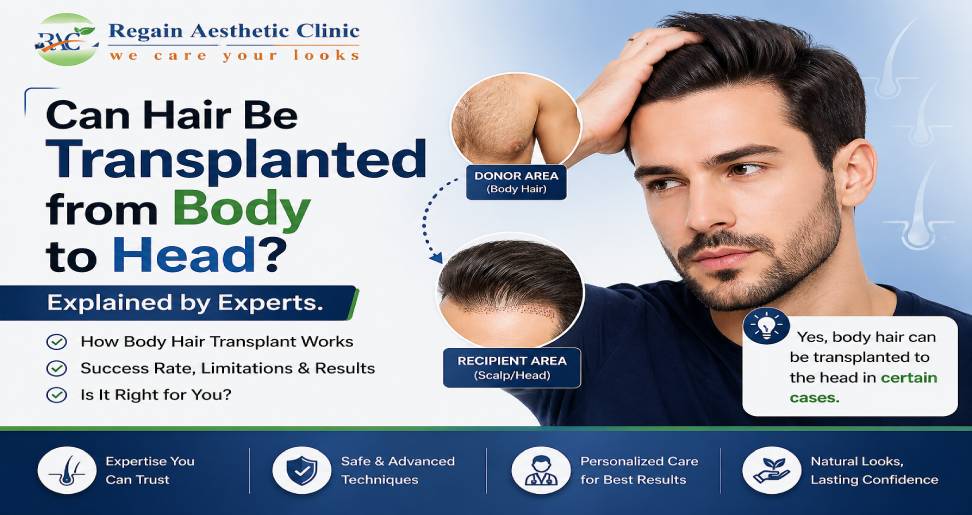
If in short anyone is looking for answer then the answer is yes, and more people should know this. Most people researching hair transplants hit the same wall eventually.
Scalp donor hair is running low. The back of the head’s already been used once, or twice. The surgeon they consulted shrugged and said there wasn’t much left to work with. And that was that.
Except, it doesn’t have to be.
Hair transplant from body hair is a real technique, it’s been done successfully for years, and awareness of it is surprisingly low. Not because it’s experimental just because most clinics don’t offer it, so most consultations never mention it.
If you’ve been told you’ve run out of options, there’s a decent chance that’s not actually true.
Where Do They Get the Hair for a Hair Transplant
The back and sides of the scalp. That’s the standard answer.
This area known as the “safe zone”, carries hair that’s resistant to DHT, which is the hormone that causes pattern baldness. Because it’s resistant, transplanted hair from this zone tends to survive long-term. It stays put. That’s the whole point.
For most people with moderate hair loss, there’s enough supply there. Grafts come out of the back of the head, go into the thinning areas, done. Straightforward.
But that supply isn’t unlimited. And for a specific group of patients, it runs out.
When the Back of the Head Isn’t Enough
Advanced hair loss changes the maths entirely.
Someone at Norwood 6 or 7, significant baldness across the top and crown, needs a lot of grafts to get meaningful coverage. But the safe zone at the back only has so much to give. Push it too hard and you either thin the donor area visibly or you don’t have enough to cover the recipient area properly. Neither outcome is good.
Then there are patients who’ve already had one or two transplants. Previous procedures already drew from that well. What’s left isn’t always enough for a second or third pass.
And some people just naturally have lower donor density. Fewer follicles per centimetre, regardless of how much hair they’ve lost overall.
In all three situations, the question becomes that what else is available?
Hair Transplant Body to Head — What’s Actually Usable
Body hair. Specifically: beard, chest, abdomen, arms, legs.
All of it can be extracted using FUE — the same punch technique used for scalp-to-scalp transplants — and implanted into the scalp. The mechanics are the same. What changes is where you’re taking the grafts from and what they look like once they grow.
Beard hair is the best performer, by a fair margin. It’s coarser, it has a longer growth cycle, and in terms of texture it sits closest to scalp hair. Beard-to-scalp results, done well, can be genuinely impressive.
Chest and torso hair works as a supplement. Good for adding density behind an established hairline or filling in mid-scalp where you’re not trying to match fine temple hair. Not a standalone solution but a useful addition.
Leg and arm hair is finer, shorter cycle, more limited in what it can achieve. Gets used in specific scenarios. Not the first choice.
The honest version: body hair rarely replaces scalp donor supply entirely. But for a lot of patients, it bridges the gap between “not enough” and “actually good coverage.”
Hair Transplant Back of Head — The Crown Problem
The crown is hard to treat well. It needs many grafts to look natural because of how hair fans outward from the centre and underfilling it looks worse than leaving it alone, which is a trap some clinics fall into.
When scalp supply is tight and the crown still needs work, beard grafts mixed into the remaining scalp donor supply can make a real difference. The blend requires experiencematching angles, placing different textures in the right zones but when it’s done properly, the result reads as natural under normal conditions.
Not the same as a full crown. But a legitimate improvement over visible scalp.
What the Procedure Actually Involves
Body hair FUE takes longer per graft than scalp work. The follicular units are more spread out across the skin surface, extraction requires more precision, and larger cases usually get split across two or more days rather than one long session.
Implantation is the same as standard FUE. Channels, correct angle, correct depth, correct direction. Growth starts showing around month four. Full results take twelve months, sometimes longer with body hair because its growth cycle differs from scalp hair.
Recovery involves scabbing and redness at both scalp and body donor sites. Resolves in ten to fourteen days. Nothing dramatic.
Before You Book a Consultation
A few things that matter and don’t get said enough:
- Beard hair almost always outperforms other body sources for scalp transplants. If you’re exploring BHT, that’s where to start
- A depleted scalp donor zone doesn’t mean the case is closed, it means the assessment needs to go further
- Body hair texture varies a lot between people. What’s available to you specifically needs proper evaluation, not a general answer
- The surgeon’s experience with body hair transplant specifically not FUE generally, is what determines the result
- Realistic expectations are part of the process. Know what you’re supplementing, not replacing
Frequently Asked Questions ( FAQs) :-
Ans :- Not exactly, it keeps some of its original characteristics, particularly growth cycle and texture. Beard hair adapts the best. Results are natural-looking but may feel slightly different from native scalp hair, especially in the first year.
Ans :- Both donor and recipient areas get numbed before anything happens. Most people describe pressure, not pain. Post-procedure soreness at body donor sites settles within a week.
Ans :- People with depleted or limited scalp donor zones. Those needing supplemental grafts after previous procedures. Anyone with advanced hair loss where scalp supply alone won’t cover the target area adequately.
Ans :- Usually yes. More time per graft, often multiple sessions. Total cost depends on how many grafts are needed and what combination of donor sources gets used.
Final Thoughts
A lot of people have quietly accepted that their options are exhausted. Sometimes that’s true. Often it isn’t.
Body hair transplant exists, it works for the right candidate, and it’s expanded what’s achievable for cases that used to be considered too difficult. The gap between “limited donor supply” and “no options” is wider than most clinics acknowledge.
Regain Aesthetic works through the full picture starting from scalp donor availability, body hair suitability, previous procedure history before drawing any conclusions. If you’ve been given a verdict elsewhere that didn’t feel complete, a second assessment is worth having.
Have A Look :-
