The problem that gets missed for years, a blocked nose that never fully clears. Waking up tired no matter how long you slept. A partner who complains about snoring you can’t actually hear yourself doing. Months of nasal sprays that sort things out for three weeks and then stop working.
And every appointment, some version of: it’s probably allergies. Try this spray. Come back if it gets worse.
At Reagin Aesthetic we see this pattern constantly. Patients who’ve been managing something with temporary fixes for years, sometimes the better part of a decade, because nobody connected the dots back to a structural problem. A deviated septum. Enlarged turbinates. A physical obstruction that doesn’t respond to medication because medication doesn’t move cartilage.
Submucosal resection exists for exactly this situation. Most patients who need it have never been told it’s an option.
What Is Submucosal Resection?
The nasal cavity is split down the middle by the septum, a wall of cartilage and bone. When that wall veers off to one side, the airway on that side narrows. Air struggles through. The other side often swells in response, which adds another layer of obstruction.
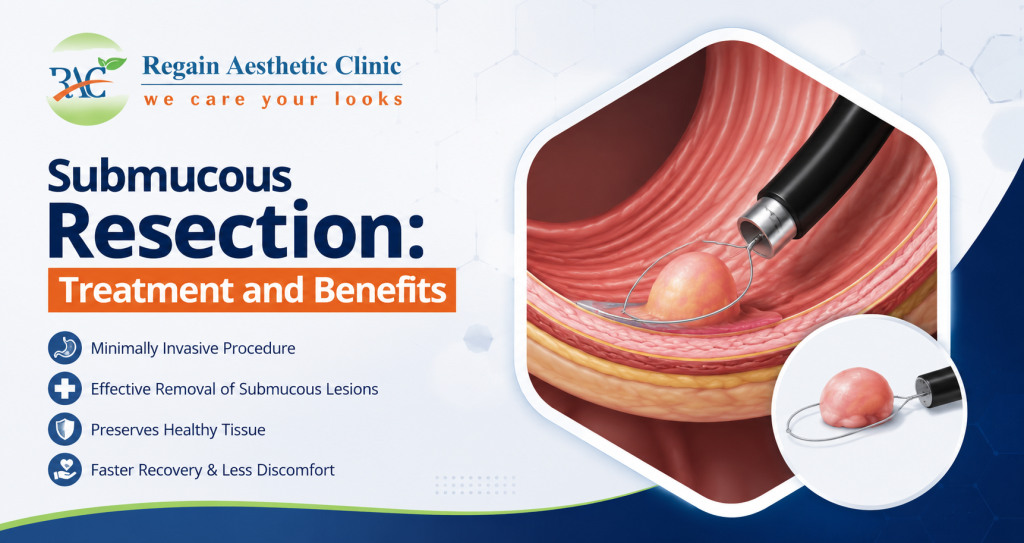
Submucosal resection fixes this by going beneath the mucous membrane lining of the septum, removing the deviated cartilage and bone from underneath it, and leaving the lining itself in place. No incision on the outside of the nose. No change to how the nose looks from the outside. Just a corrected airway on the inside.
Septoplasty vs Submucosal Resection. What’s the Actual Difference?
Patients ask this at almost every consultation and the confusion makes sense because the terms get used loosely.
Septoplasty is the general label for any surgery that corrects a deviated septum. Submucosal resection is a specific method within that category. The distinction is in how tissue is handled. In submucosal resection the mucoperichondrial lining gets lifted, the structural problem beneath it gets removed, and then the lining sits back down over the site undisturbed.
Why does that matter? Preserving the lining means less bleeding during surgery. Faster healing after. Lower chance of scarring or the kind of perforation that creates new problems. It’s the more careful version of the procedure and the one we use at Reagin Aesthetic.
If a surgeon describes their technique and doesn’t mention mucosal preservation, ask about it.
The Medication Problem
Most patients coming to us have already spent time and money on nasal sprays and decongestants. Some of them have had allergy testing. Some have tried antihistamines for a year.
Here is the honest version of why none of that worked permanently.
Medication reduces inflammatory swelling. It doesn’t move structural tissue. A septum that has deviated to one side does not respond to a spray any more than a bent joint responds to ibuprofen. The inflammation around it may calm down temporarily. The deviation stays exactly where it is. Symptoms come back. Usually within weeks.
This is not a failing of the medication. It’s a category error. Using anti-inflammatory treatment for a structural problem is treating the symptom and leaving the cause completely untouched.
How Risky Is Turbinate Reduction Surgery?
Less risky than staying blocked. That’s the honest framing.
Turbinates are the bony shelves inside the nose that condition incoming air. Chronically enlarged turbinates are often part of the same obstruction picture as a deviated septum and frequently get treated at the same time. Reduction involves shrinking the tissue, not removing it entirely. Removing turbinates entirely causes empty nose syndrome, which is significantly worse than the original problem. That’s not what happens in a properly performed procedure.
What the recovery actually involves:
- congestion for the first week or so,
- some crusting,
- occasionally small amount of bleeding as healing progresses.
These are expected and temporary. Serious complications are uncommon.
Compare that to what continued chronic mouth breathing does over years. Sleep quality degrades. Dental health suffers. Cardiovascular function is affected. The fatigue that comes from years of poor sleep is not nothing. Patients who’ve had submucosal resection almost always say they wish they’d looked into it sooner.
What the Weeks After Surgery Look Like?
Week one congested, blocked, bruised feeling in the nose. This is the worst stretch and most patients know it going in which helps. Saline rinses every few hours. Rest.
Week two. Things start to shift. The first clear breath through the nose usually happens somewhere in here and patients describe it in similar ways. Something they’d forgotten they were missing.
Six to eight weeks for full resolution as post-surgical swelling settles completely. Results continue to improve through that window.
Before the Procedure
Stop blood thinners and aspirin ten days before surgery. Mention any previous nasal procedures or history of bleeding to the surgeon. Have a plan for getting home and staying home for the first night.
Ask specifically whether turbinate reduction will be done alongside the septoplasty. If both problems are present and only one gets addressed, the improvement is going to be partial.
FAQs
What is a submucosal resection?
Surgery to correct a deviated septum by removing deviated cartilage and bone from beneath the mucosal lining while keeping that lining intact. Better airflow. Same nose on the outside.
What is the difference between septoplasty and submucosal resection?
Septoplasty is the broad category. Submucosal resection is the tissue-preserving technique within it. In practice the terms are used together. The important part is that the mucosal lining is preserved.
How risky is turbinate reduction surgery?
Low risk with an experienced surgeon. Temporary congestion, minor bleeding, and healing crusting are the normal post-operative experience. Serious complications are uncommon.
The Part That Catches Patients Off Guard
Not the surgery, the results which give better sleep, more energy. The chronic low-level exhaustion that had become normal starts to lift and patients realise in retrospect how much the obstruction was affecting them. The change is bigger than expected because the problem was bigger than they realised.
Reagin Aesthetic provides submucosal resection and turbinate reduction with full assessment before and follow-up care after. If blocked nasal breathing has been part of daily life for longer than it should have been, that conversation is the right place to start.
Read More: